Limber Outcomes handles the work of collecting patient-reported outcome measures (PROMs), so your team can focus on what the results mean for each patient.
Assessments go out automatically before the visit by email or text, and patients can complete them in the Limber app or in the clinic, with no action required from therapists.
PROMIS computer adaptive tests and widely used legacy measures, with Limber's crosswalk translating PROMIS scores into legacy scores when providers or payers need them.
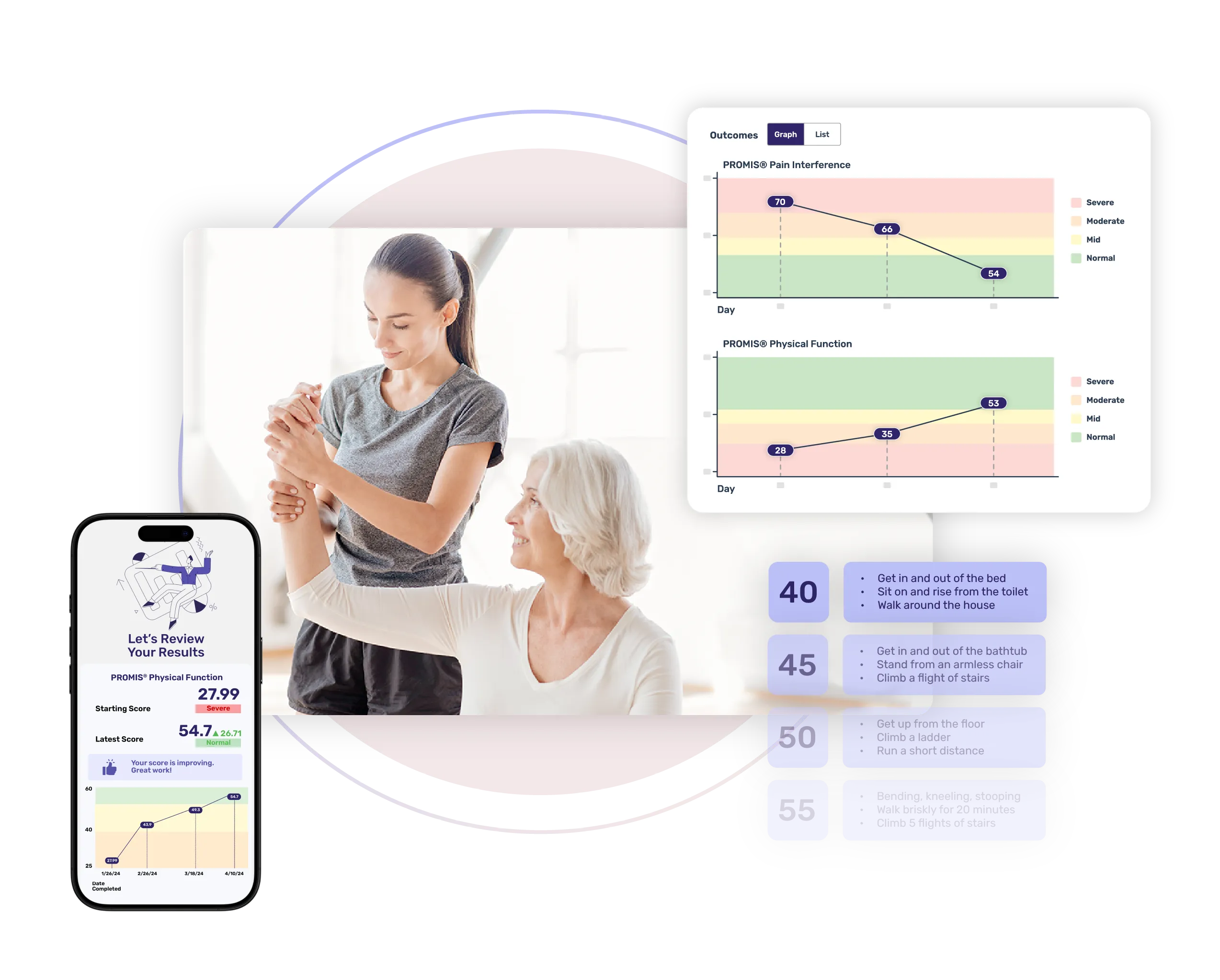
See each patient's scores over time, and with Recovery Forecast, how they compare with what's expected.
Benchmark risk-adjusted results and report MIPS quality measures through Limber's CMS-approved QCDR, all from the same data.
Integrations with major EMRs fit Limber Outcomes into the workflow your team already uses.
Limber Outcomes, home exercise programs, and Remote Therapeutic Monitoring share one provider platform and one login, so there are no separate systems to manage.
Outcome measures have traditionally been reviewed at discharge, after the chance to adjust care has passed. Recovery Forecast gives clinicians a reference point during care.
Using risk adjustment at intake and the largest outcomes database in rehab therapy, with more than 284 million completed patient-reported outcome measures collected over decades, Recovery Forecast predicts each patient's expected path on their primary outcome measure across the first 90 days. At every reassessment, clinicians see the actual score against that prediction, so they can change the course of care while the patient is still in treatment.

See at a glance whether each patient is on track, compared with what's expected for someone who started where they did.
P-MCI marks each patient's predicted score at day 56. Where MCID applies a single fixed threshold, P-MCI reflects what meaningful improvement looks like for each patient. It's already part of commercial payer quality programs.
Recovery Forecast comes with every Limber Outcomes subscription, with no separate add-on to buy and clinicians can toggle between the Forecast and Classic views for patient progress.
Download our free comprehensive guide to MIPS reporting for 2026. Inside you'll find tips, tricks, and helpful guidance on all things MIPS submission.

Limber Outcomes turns patient-reported outcomes into a clinical tool, built for rehab therapy and backed by the largest outcomes database in the field.

See how each patient is progressing, and with Recovery Forecast, how that compares with what's expected, to guide the plan of care.

Short assessments patients can answer on their phone, laptop, or in the clinic, so completing them fits easily into their day.

Benchmark risk-adjusted results against other Limber users and national averages, by region of injury, provider, location, and TaxID.

Share outcomes data that demonstrates the value of your care to referral sources and payers, and support participation in value-based care.

Report through Limber's CMS-approved QCDR, with eligibility verification, risk adjustment, and pre- and post-submission audits. Learn about the QCDR

Assessments go out automatically pre-visit by email and text, or can be completed in the clinic, so staff don't have to schedule or chase surveys.





Patient-reported outcomes collection is the process of gathering standardized surveys, called patient-reported outcome measures (PROMs), in which patients rate their own function, pain, and quality of life. In rehab therapy, PROMs collected at intake and throughout care show whether treatment is working, inform the plan of care, and support quality reporting.
Limber Outcomes automates collection. Patients complete assessments pre-visit by email, text, or in the clinic. An initial assessment takes about three minutes and a reassessment about one minute. Reassessments are regularly sent automatically, so staff don't have to schedule or chase surveys.
Limber Outcomes supports more than 50 standardized outcome measures, including PROMIS measures and widely used legacy measures for musculoskeletal and specialty populations. Practices can collect the measures their clinicians and payers rely on in one automated workflow.
Recovery Forecast is a capability in Limber Outcomes that predicts each patient's expected path on their primary outcome measure across the first 90 days of care, using risk adjustment at intake. At every reassessment, clinicians compare the patient's actual score with that prediction, so they can tell whether care is on track and adjust the plan of care while the patient is still in treatment.
P-MCI (Predicted Moderate Clinical Improvement) is a progression indicator that marks each patient's predicted score at day 56, the point at which clinically meaningful improvement is expected. Where MCID compares a patient with a single fixed threshold, P-MCI reflects what meaningful improvement looks like for each patient, based on where they started.
Limber operates a CMS-approved Qualified Clinical Data Registry (QCDR) for outcomes reporting in the Merit-based Incentive Payment System (MIPS). The QCDR includes eligibility verification, risk adjustment, pre- and post-submission audits, and benchmarking. MIPS eligibility is determined at the individual clinician level.
Limber Outcomes risk-adjusts results so each patient is compared fairly, then benchmarks performance against other Limber users and national averages. Practices can compare results by region of injury, provider, location, and TaxID, drawing on the largest outcomes database in rehab therapy, with more than 284 million completed patient-reported outcome measures collected over decades.